
Welcome to Innovations Foresight
Innovative solutions and high quality products
for astronomy.
We share your passion for excellence.
ONAG:
ON-Axis Guider
for your best
images yet
The new
standard in
guiding
The technology
used by professionals available to
you:
- Finding a
guide star has
never been
easier!
- Presenting
your scope's field
of view to your
guider.
- No more
differential
flexure even
with long
focal.
- Integrated X/Y
stage for your
guider.
- Work with
refractors as
well as
reflectors.
- Ideal for
SCTs such as
Celestron,
Meade, ...
- Accept most focal
reducers.
- No extra load
for your mount,
weight only
770 grams (1.7
lbs).
- No rotation
necessary for
finding a guide
star.
- Enjoy reusing
your flat frames
over and over
again.
.jpg)
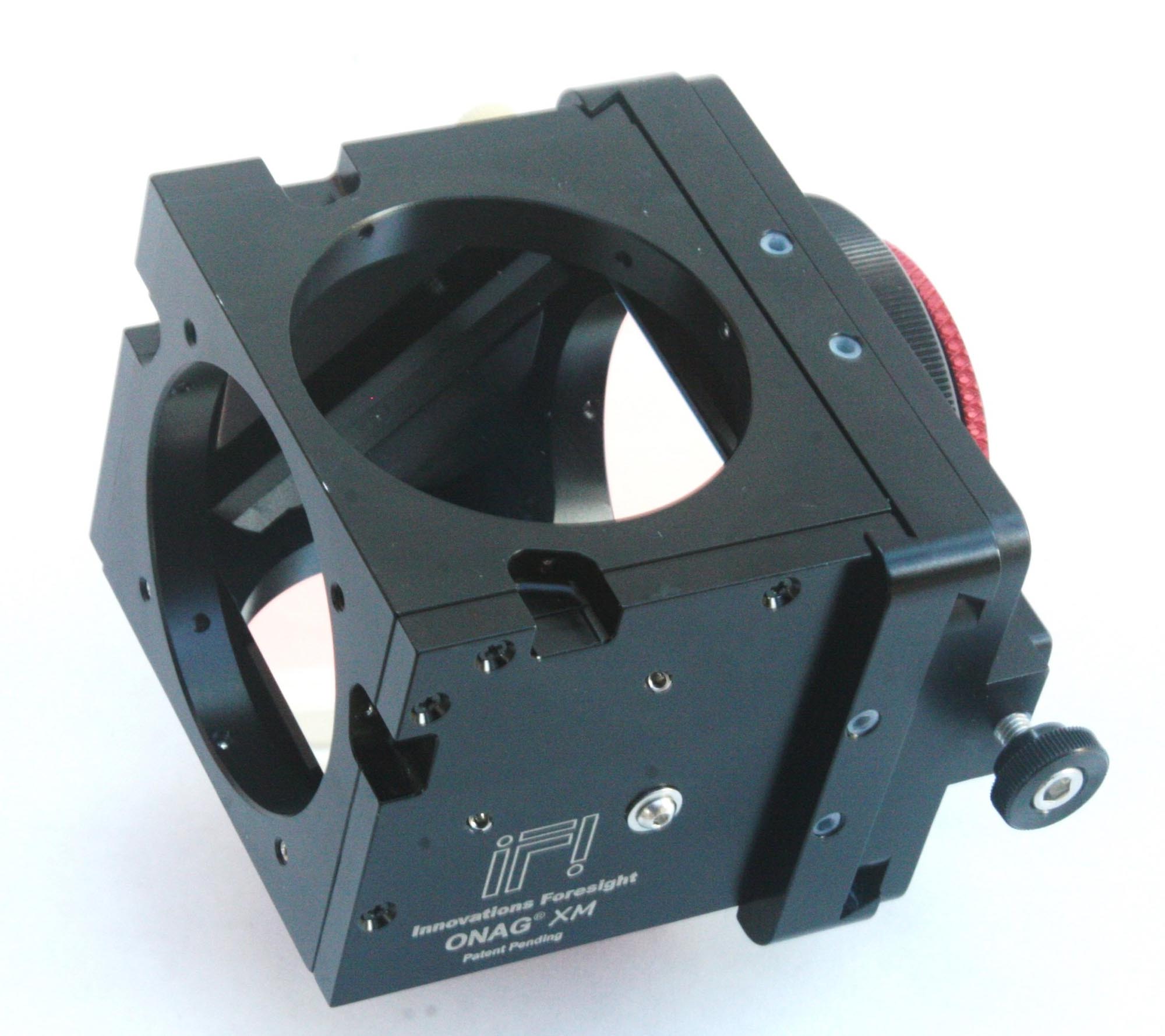
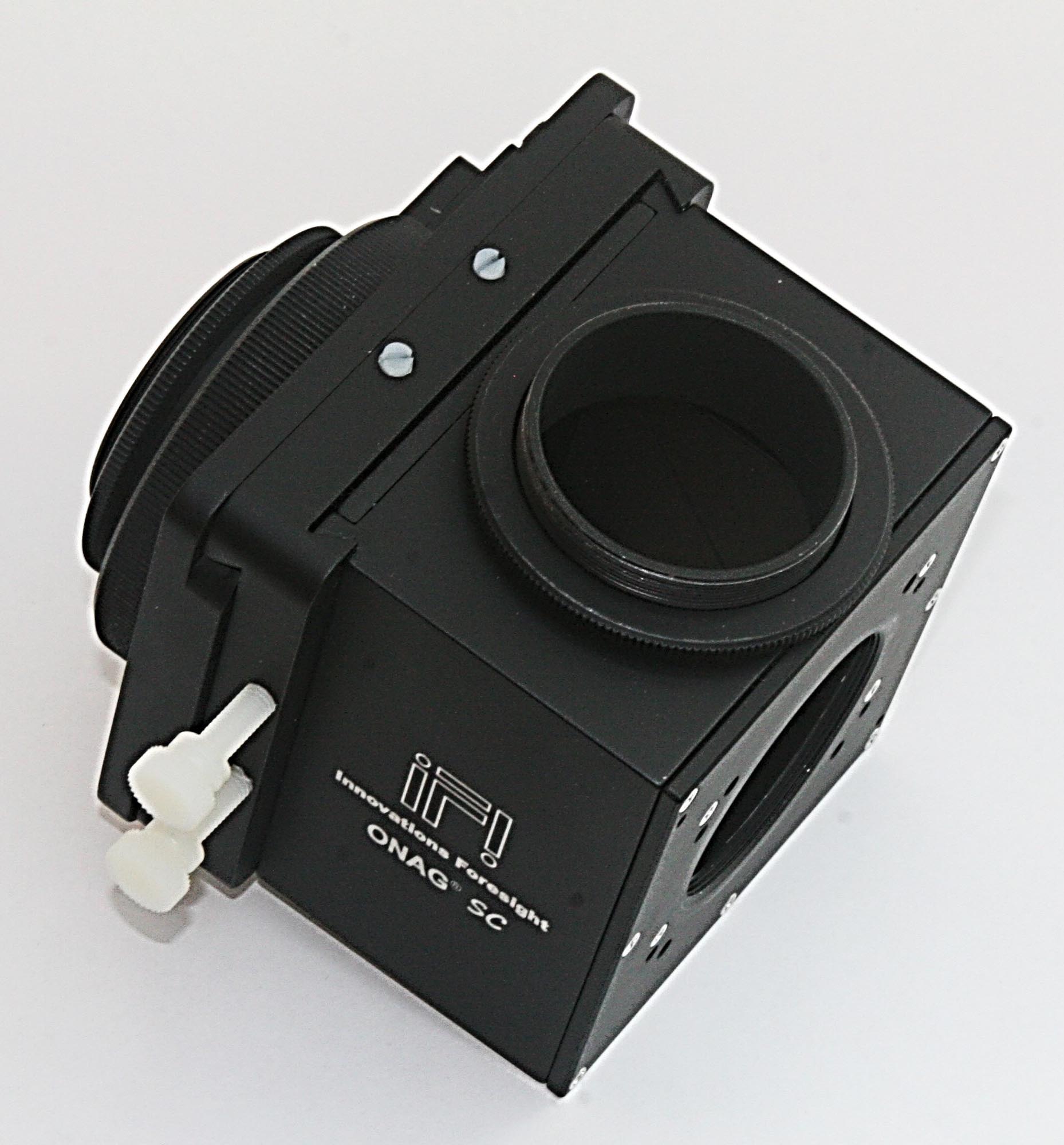
ONAG
(patent pending)

The ONAG unit ONAG
+ C8
"orange" tube
Guiding for long
exposures is
challenging, yet
a critical task.
Astronomy is one
of the most
demanding field
in photography
(see
how much guiding
error is too
much).
Astrophotography for deep space objects, associated with medium to long focal length, requires high precision accurate tracking and active guiding. Classical techniques suffer from various issues and limitations.
Guide scopes are prone to differential flexures, which are very difficult to track and fix, they also add an extra load for the mount. Another issue happens when used with SCT telescopes a possible principal mirror motion, this could happen slowly over the time of an astrophotography session due to gravity and load transfer. Even a scope with locking mirror mechanism could still exhibits some left over motion, and it does not take much more, with a long focal, to end with elongated stars.
While off-axis
guiders (OAG)
solve most of
this issue they
only provide
access to a
small field of
view, making the
search for a
guide star
challenging at
best, often a
significant
source of
frustration and
time consuming.
OAG pick-up
prisms lead to
large F numbers,
limiting the
usable maximum
guide star
magnitude. Since
by nature they
are looking well
off-axis, guide
stars could
exhibit extreme
deformations with some
scopes.
Self-guided
cameras are much
like OAG, with
an even smaller
field since
there is no
position
adjustment
possible, beside
the rotation of
the whole camera
body.
Our on-axis guider ONAG solves those problems, providing you with easy access to a wide field of view without any differential flexure or significant extra load for your set-up. The ONAG weights only 770 grams (1.7 lb). Since it uses the same scope, and optical train than your imager it provides maximum light to your guider camera. The ONAG works by splitting the light into two components.
The
visible range,
from 370nm to
750nm, is sent
to your imager
camera, while
the near
infrared (NIR)
range, above
750nm, is
transmitted to
the guider
camera. This
patent pending
design uses a
dichroic beam
splitter,
basically a
selective
mirror, set a 45
degrees. The
light received
by your imager
is reflected,
this insures
there is no
optical
aberration
involved in the
process, this is
no different
than a star
diagonal.
Our dichroic
mirror is made
of high quality,
very low thermal
expansion,
optical grade
glass and will
not experience
any deformation
even when
exposed to an
extended
temperature
range. Our
goal and
commitment has been
not to
compromise with
your image
quality, ever.
Unfiltered CMOS,
CCD cameras are
sensitive in
NIR. More than
76% of the
main
sequence
stars
have surface
temperatures
lower than 3700K
(red) radiating
large amount of
infrared energy.
Therefore they
are a good
candidates for
NIR guiding.
Indeed this is
the technology
used by the
professionals,
now made
available to you
as well.
Want to know
more about
guiding error
and near
infrared (NIR)?
Visit:
"Guiding
with NIR"
and "How
much guiding
error is too
much?"
ONAG Basic Principal
The visible
NIR cut-off
wavelength at
750nm gives full
access for
imaging using H
Balmer alpha
band. Since
filters and
filter wheels
are placed in
the imager's
optical path,
they will not
interfere with
the guider
camera.
Therefore even
narrow band
imaging will not
make the guide
star too dim to
use anymore.
The
ONAG will work
well with many
scopes,
refractors as
well as
reflectors, provided
you have the
necessary back
focus (see
our product page
or
ONAG user manual).
It excels with
long focal such
as
Schmidt
Cassegrain type
scopes
(SCT), such as
Celestron,
Meade, ...
The ONAG works
with almost any
focal reducers
(FR), a NIR
optimized
adjustable focal
reducer (AFR)
using aspheric
optics
is also
available from
IF for your
guider. The
AFR is
designed to be
used with your
FR/corrector when the
later is placed
in front of your
imager, at the
ONAG's imager
port (IP).
Alternatively you can place
most FR/corrector in front
of the ONAG, see the
FAQs section
and the
ONAG user manual
for further
information.
The ONAG is made of high quality aluminum and stainless steel. The optical beam splitter is fully multi-coated and protected with a transparent layer of quartz to provide a long life.
Unlike
standard black
anodizing, which
is transparent
in NIR, and
may break down
over time causing lens
cloudiness, as
well as reduced
efficiency, our
product is made
of optical grade
quality
anodizing. It
absorbs up to 5
times more light
than standard
anodizing with
an extended
spectral
performance way
above 1200nm.
ONAG a flexible and versatile solution
ONAG mounted
on Hyperion
12.5".
Imager: Apogee
U8300 + filter
wheel.
Guider: SBIG
ST402.
Credit: Frank
Colosimo,
Blue Mtn Vista
Observatory

ONAG mounted
on C11-CGE with
SBIG AO8
adaptive optic
module and an
OPTEC TCF-S
focuser
Imager:
ST4000XCM with
focal reducer
f/6.3 and filter
wheel (skyglow
imaging filter).
Guider:
Home made
guider.
Credit: Dr.
Gaston Baudat,
IF's CTO.
Glenmoore
observatory PA -
USA
The ONAG has
been optimized
for CCD imagers
using large
format APS-C
chips. The
imager camera
can be attached
to the ONAG
imager port
using a standard
T-thread
(M42x.75mm) connection.
Searching for a
suitable guide
star has never
been easier
thanks to its
wide field of
view and
convenient quick
set-up X/Y
stage, providing
an exploration
circle up to 46
mm (1.8”) in
diameter.
This
is more than 1.3
arc-degrees for
a two meters
focal length
scope.
The guider
camera is
attached at the
ONAG guider port
with a male
T-thread . However
the ONAG
build-in focuser
drawtube can be
removed allowing
to use any
standard
1-1/4" nosepiece
instead*. This
is particularly
handy if your
guider nosepiece
can not be
removed. See
FAQs for
guide star
focusing
procedure and
comments.
Should you have
an adaptive
optic modules,
such as the SBIG
AO8, you can use
it with our
ONAG, see the
ONAG user manual
for further
information. We
also offer an
AO8 adaptor
plate for
the ONAG.
*
An extra 1-1/4"
extension tube
could be
necessary to
reach focus.
SLR and DSLR
cameras can be
easily mounted
on the ONAG
using a standard
T-thread
connection.
This make the
ONAG a very
versatile tool.
whatever you use
a astronomical
CCD or a DSLR
camera.
ONAG with DSLR

ONAG mounted on
ORION EON
apochromat
refractor with a
DSLR (Canon
EOS)
Guider: ORION
Starshoot
autoguider
The ONAG comes
with a variety
of extension
tubes, which
associated with
a compressed
ring focuser at
its guider port,
allow a very
large range of
imagers and
guiders to reach
focus.
See the
ONAG user manual
for further
information.
The ONAG is
attached to your
scope using a
standard
T_thread. For
convenience it
comes with a low
profile male
T-thread to
female SCT
adapter, as well
as male T-thread
to 2" tube
adapter.
IF offers also a
compact
AP 2.7" adaptor.
ONAG unit,
extension tubes,
and scope
adaptors

ONAG unit and
the included
parts.
ONAG and
spectroscopy
Astronomical
spectroscopy
requires to keep
the object under
analysis, star,
nebula, ...,
centered on the
spectrograph
slit.
Here the ONAG
can be used as
well for precise
guiding,
allowing to
track the
analyzed star,
or another one
with the same
scope focal
and optical
train than for
the
spectrograph.
Most of the
spectral
features happen
between 350nm to
750nm. This is
also the range
for most of
commercially
available
spectrograph for
amateurs.
The ONAG's
dichroic beam
splitter has
been designed to
keep this
spectral range
available to
your imager, and
spectrograph as
well. The ONAG
mirror's cut-off
wavelength is
set at 750nm.
The next picture
shows the ONAG
used for
spectroscopy
with a C11, a
SBIG DSS-7 and
associated ST7
camera.
ONAG with
spectrograph

ONAG with a SBIG DSS-7 spectrograph + ST7 camera on C11


.svg.png)


